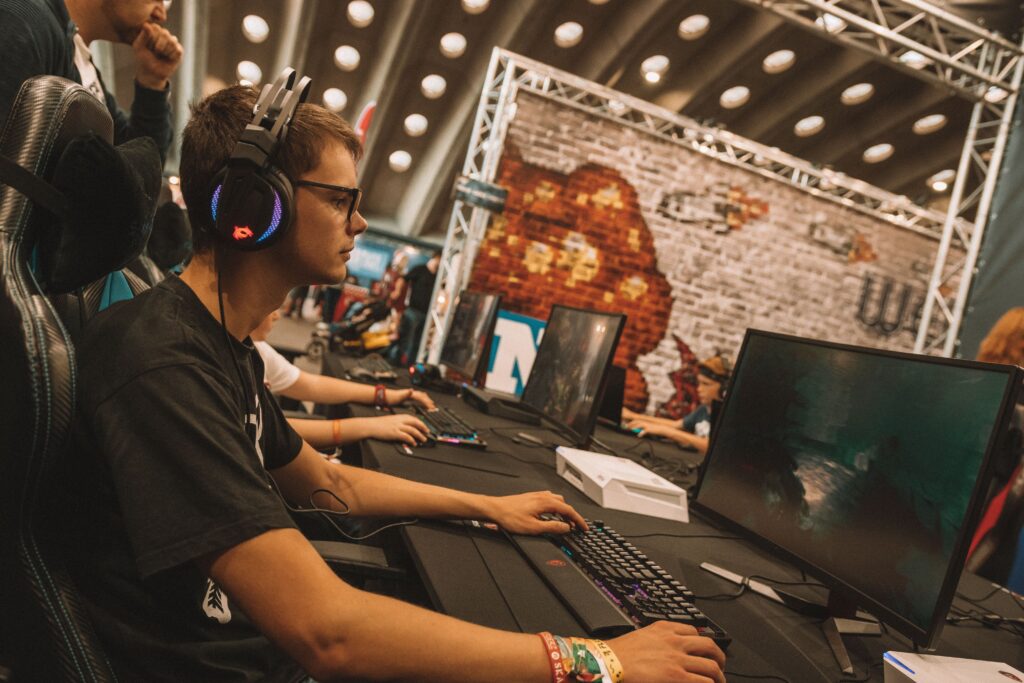
Over the past forty years, gaming has undergone an unrecognisable transformation. What started as a solitary activity, one person against a screen, has evolved into a vast, interconnected ecosystem centred on community involvement, live interaction, and shared experiences.
Real-time human connection has become a defining feature of modern gaming, whether you’re competing in an esports tournament, watching a Twitch streamer, or interacting with a live host during an online gaming session.
This transformation didn’t happen overnight. It reflects broader shifts in society, technology, and consumer expectations for digital entertainment.
Real-time interaction across digital entertainment
Beyond traditional gaming, demand for live, interactive experiences has grown rapidly. Real-time participation has become a core feature across digital entertainment rather than an optional extra.
Live in-game events, such as Travis Scott’s and Ariana Grande’s Fortnite concerts, demonstrated that virtual worlds could become cultural moments in their own right. Players weren’t simply spectators: they participated in experiences unfolding in real time, sharing moments that felt unique and communal.
This same principle applies to real-time live casinos, where players engage directly with human hosts and watch outcomes unfold as they happen. Rather than relying solely on automated systems, live casinos use high-definition video streaming and optical character recognition technology to deliver genuine human interaction at scale.
Players communicate through live chat, respond to hosts, and experience each game as it unfolds, creating an atmosphere that closely resembles sitting at a physical gaming table.
According to Grand View Research, growing demand for more authentic and socially engaging online experiences has fueled the rapid expansion of the global live casino market. This mirrors a broader trend across gaming and digital entertainment, where active participation has increasingly replaced passive consumption.
From single-player roots to networked play
Early video games were largely solo experiences. Classics like Pac-Man, Tetris, and Super Mario Bros. challenged individual players to beat high scores or race against the clock. Local multiplayer eventually brought friends together on the same couch, while 1990s LAN parties expanded those connections across living rooms and basements.
The real turning point, however, arrived with the widespread adoption of the internet. Broadband dramatically reduced geographical barriers. Suddenly, players could team up or compete with others across continents. Games such as Counter-Strike and World of Warcraft transformed gaming from an individual pastime into a thriving network of global communities.
Today, games aren’t just software to play. They’re digital gathering places, shared rivalries, and ongoing conversations. Success is no longer measured solely by beating the game but also by the people you experience it with.
The rise of esports and broadcast culture
Competitive gaming has grown from informal online matches into a global industry. Today, millions of people watch esports tournaments both online and in packed arenas. Events such as the League of Legends World Championship and The International for Dota 2 rival traditional sporting events in production quality, audience size, and global reach.
Live broadcasting fundamentally changed the relationship between players and audiences. Spectators now do far more than simply watch. They participate through live chat, polls, predictions, and community discussions that unfold alongside the competition. Platforms like Twitch and YouTube Gaming have built entire ecosystems around this level of audience engagement.
According to Statista, global esports revenue exceeded USD 1.8 billion in 2022, while worldwide viewership continues to grow year after year. The appetite for real-time interactive entertainment extends well beyond playing games. Watching them has become an increasingly participatory experience.
Streaming, creators, and the audience relationship
Twitch reshaped the idea of who could become an entertainer. Independent creators built audiences ranging from thousands to millions through live gameplay broadcasts. What made this format compelling wasn’t just the gameplay itself but the direct connection between streamer and viewer.
Live chat enabled real-time interaction that traditional media struggled to replicate. Viewers could leave a comment and receive a response within seconds. Donations triggered on-screen alerts, while subscriber milestones became shared celebrations. The audience wasn’t simply watching the performance; they became part of it.
This model quickly spread across platforms. YouTube expanded its live-streaming capabilities. TikTok introduced live gifting, while Instagram and Facebook integrated live video with direct audience participation. As a result, audiences began expecting immediate interaction as a standard part of digital entertainment.
Creator communities extended these experiences even further. Discord servers, subreddits, and fan-created wikis kept conversations going long after a stream had ended. Gaming culture evolved into a continuous, around-the-clock community, with live moments serving as the focal points that brought people together.
In-game events and the future of shared moments
Game developers increasingly use live events to keep players engaged between major updates. Whether it’s a seasonal event, a limited-time game mode, or a map that changes before players’ eyes, these experiences create a shared sense of anticipation. They spark conversations, dominate social media feeds, and generate collective excitement that static experiences rarely achieve.
Looking ahead, the industry is embracing augmented reality (AR), virtual reality (VR), and artificial intelligence (AI) to make interactive experiences even more immersive. As The Guardian has noted in its coverage of immersive technology, audiences increasingly expect entertainment to recognise, respond to, and adapt to their presence in meaningful ways.
Video games have consistently evolved alongside changing player expectations. Today, those expectations centre on being present in the moment, participating as events unfold, and feeling connected to living digital worlds. Across every corner of the industry, developers continue to build experiences that make those connections possible.
Beyond the screen
Gaming is no longer just a solitary escape. It has become a place where communities gather, compete, and connect in real time. While great gameplay remains essential, today’s experiences are increasingly defined by the people sharing them. As technology continues to evolve, real-time interaction will remain one of the driving forces shaping the future of digital entertainment.
 Thomas Salasticsen has opinions about esports insights and analysis. Informed ones, backed by real experience — but opinions nonetheless, and they doesn't try to disguise them as neutral observation. They thinks a lot of what gets written about Esports Insights and Analysis, Game Reviews and Ratings, Upcoming Tournaments and Events is either too cautious to be useful or too confident to be credible, and they's work tends to sit deliberately in the space between those two failure modes.
Reading Thomas's pieces, you get the sense of someone who has thought about this stuff seriously and arrived at actual conclusions — not just collected a range of perspectives and declined to pick one. That can be uncomfortable when they lands on something you disagree with. It's also why the writing is worth engaging with. Thomas isn't interested in telling people what they want to hear. They is interested in telling them what they actually thinks, with enough reasoning behind it that you can push back if you want to. That kind of intellectual honesty is rarer than it should be.
What Thomas is best at is the moment when a familiar topic reveals something unexpected — when the conventional wisdom turns out to be slightly off, or when a small shift in framing changes everything. They finds those moments consistently, which is why they's work tends to generate real discussion rather than just passive agreement.
Thomas Salasticsen has opinions about esports insights and analysis. Informed ones, backed by real experience — but opinions nonetheless, and they doesn't try to disguise them as neutral observation. They thinks a lot of what gets written about Esports Insights and Analysis, Game Reviews and Ratings, Upcoming Tournaments and Events is either too cautious to be useful or too confident to be credible, and they's work tends to sit deliberately in the space between those two failure modes.
Reading Thomas's pieces, you get the sense of someone who has thought about this stuff seriously and arrived at actual conclusions — not just collected a range of perspectives and declined to pick one. That can be uncomfortable when they lands on something you disagree with. It's also why the writing is worth engaging with. Thomas isn't interested in telling people what they want to hear. They is interested in telling them what they actually thinks, with enough reasoning behind it that you can push back if you want to. That kind of intellectual honesty is rarer than it should be.
What Thomas is best at is the moment when a familiar topic reveals something unexpected — when the conventional wisdom turns out to be slightly off, or when a small shift in framing changes everything. They finds those moments consistently, which is why they's work tends to generate real discussion rather than just passive agreement.