Halfway through 2026, the iGaming world feels like a different animal from the one that rode the post-pandemic wave a few years back. Four names keep coming up when you look at the Year-End 2025 financials and the Q1 2026 interim data. These aren’t just companies having a good run — they’re actively changing what the industry looks like.
1. Evolution AB: The Efficiency Juggernaut
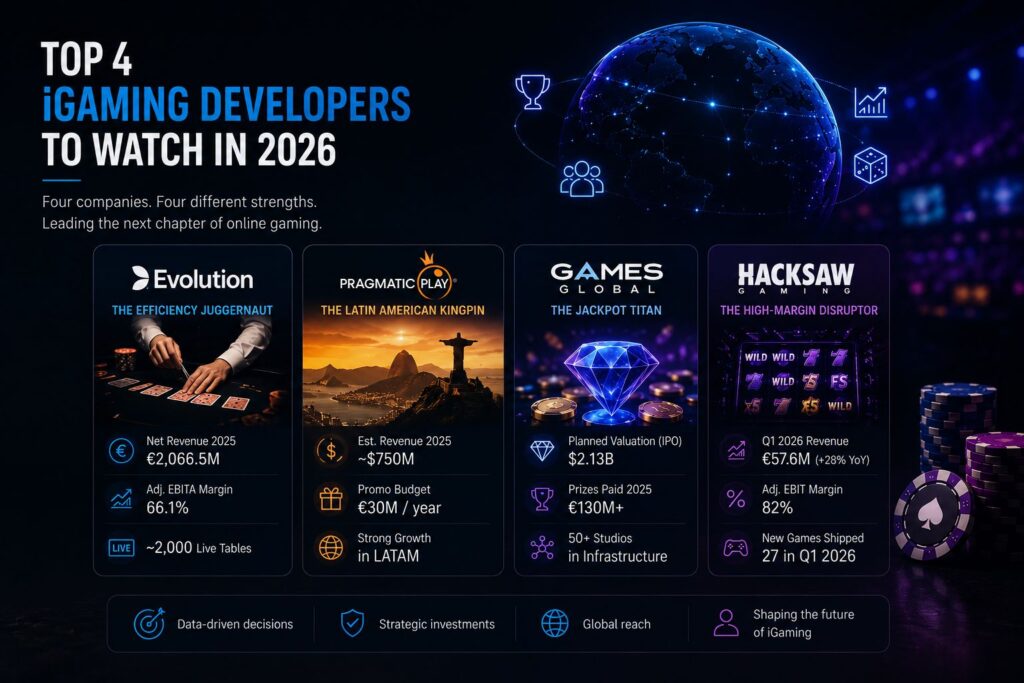
There’s a version of 2025 where Evolution’s story looks flat on paper — net revenues of EUR 2,066.5 million, revenue growth crawling along at 0.2% year-on-year, currency headwinds doing their damage, regulatory ring-fencing choking off certain markets. Look a little closer, though, and the operational picture tells you something else entirely.
An adjusted EBITDA margin of 66.1% for the full year. Think about what that actually means — for every euro that walks through the door, more than 66 cents stays as operational profit. That’s not a margin; that’s a moat. The company closed 2025 running approximately 2,000 live tables, a meaningful jump from where it stood twelve months earlier. Polish bookmakers took notice: Evolution’s portfolio includes no Nolimit City after a deal worth up to EUR 340 million. And a freshly signed 2026 partnership with Hasbro is about to bring some genuinely recognizable household names onto the live casino floor.
2. Pragmatic Play: The Latin American Kingpin
Pragmatic Play doesn’t publish financials, which makes pinning down the full picture tricky. But industry estimates from late 2025 put annual revenue somewhere around $750 million, and when you look at how they operate, that number doesn’t surprise anyone.
The “Drops & Wins” promotional campaign — currently funded at EUR 30 million per year — remains the largest prize pool a provider has ever put their own money behind. That investment has been paying geographic dividends. The October 2025 opening of a live studio in Colombia was a statement of intent for Latin America, a region that’s been growing faster than almost anywhere else in the global market. The awards followed naturally: Gates of Olympus 1000 swept the 2025 Blask Awards for Slot of the Year. Pragmatic’s formula — mobile-first design, localized content, relentless output — has made them genuinely difficult for operators to live without.
3. Games Global: The Jackpot Titan
Games Global pulled its IPO in 2024 — a planned listing that had been targeting a valuation of $2.13 billion — and chose instead to let performance do the talking. It was a reasonable gamble. In 2026, the company operates as the industry’s most significant aggregator, with a network of more than 50 independent studios plugged into its infrastructure.
The real competitive advantage here is the jackpot network, and it’s a serious one. When a UK player walked away with £11.5 million from the original Mega Moolah in June 2025, it didn’t just make headlines — it reignited a wave of jackpot interest that the whole industry felt. Over the course of 2025, Games Global paid out more than EUR 130 million in prizes across the Mega Moolah and WowPot series combined. By positioning itself as a central hub rather than a single studio, the company offers a content range that no standalone developer can realistically match. For operators chasing retention numbers, that kind of variety is hard to walk away from.
4. Hacksaw AB: The High-Margin Disruptor
If one company captures the spirit of 2026, it might be Hacksaw AB. Listed on Nasdaq Stockholm under HACK.ST, the studio has travelled a long way from its scratch-card origins — it’s now operating as a fully-fledged B2B technology platform, and the numbers back that transformation up completely.
Q1 2026 revenue hit EUR 57.6 million, up 28% on the same period last year. The adjusted EBIT margin came in at 82%, which is the kind of figure that makes people in this industry do a double-take. Twenty-seven new games shipped in the first quarter alone, and the OpenRGS platform — now home to nine third-party studios — is quietly becoming the company’s most important long-term asset.
The Wrap-Up: A Year of Calculated Risks
These four companies aren’t just doing well — they’re setting the tempo for everyone else. Evolution’s live infrastructure, Pragmatic’s geographic reach, Games Global’s jackpot ecosystem, Hacksaw’s borderline absurd profit margins — each represents a different answer to the same question: how do you stay relevant when the market stops being easy? For anyone watching the digital entertainment space, whether as a fan, a bettor, or just someone curious about where the money flows, these are the names worth paying attention to for the rest of the year.
 There is a specific skill involved in explaining something clearly — one that is completely separate from actually knowing the subject. Jacobilly Christopherson has both. They has spent years working with latest gaming news in a hands-on capacity, and an equal amount of time figuring out how to translate that experience into writing that people with different backgrounds can actually absorb and use.
Jacobilly tends to approach complex subjects — Latest Gaming News, Esports Insights and Analysis, Expert Commentary being good examples — by starting with what the reader already knows, then building outward from there rather than dropping them in the deep end. It sounds like a small thing. In practice it makes a significant difference in whether someone finishes the article or abandons it halfway through. They is also good at knowing when to stop — a surprisingly underrated skill. Some writers bury useful information under so many caveats and qualifications that the point disappears. Jacobilly knows where the point is and gets there without too many detours.
The practical effect of all this is that people who read Jacobilly's work tend to come away actually capable of doing something with it. Not just vaguely informed — actually capable. For a writer working in latest gaming news, that is probably the best possible outcome, and it's the standard Jacobilly holds they's own work to.
There is a specific skill involved in explaining something clearly — one that is completely separate from actually knowing the subject. Jacobilly Christopherson has both. They has spent years working with latest gaming news in a hands-on capacity, and an equal amount of time figuring out how to translate that experience into writing that people with different backgrounds can actually absorb and use.
Jacobilly tends to approach complex subjects — Latest Gaming News, Esports Insights and Analysis, Expert Commentary being good examples — by starting with what the reader already knows, then building outward from there rather than dropping them in the deep end. It sounds like a small thing. In practice it makes a significant difference in whether someone finishes the article or abandons it halfway through. They is also good at knowing when to stop — a surprisingly underrated skill. Some writers bury useful information under so many caveats and qualifications that the point disappears. Jacobilly knows where the point is and gets there without too many detours.
The practical effect of all this is that people who read Jacobilly's work tend to come away actually capable of doing something with it. Not just vaguely informed — actually capable. For a writer working in latest gaming news, that is probably the best possible outcome, and it's the standard Jacobilly holds they's own work to.